The Transformation of Student Engagement: From Partnership to Power (NUS Guest Post)
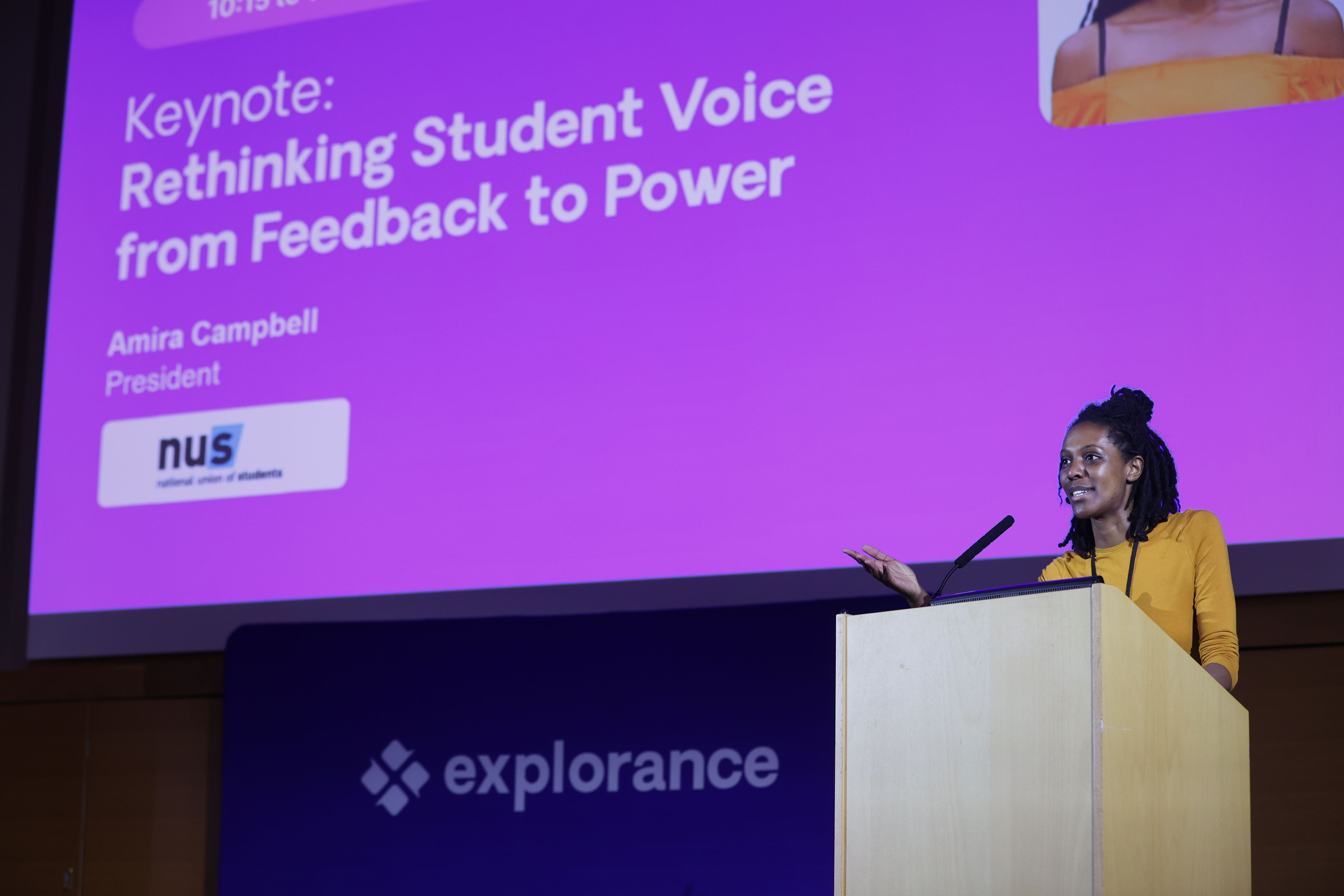

Amira Campbell, President of the National Union of Students (NUS), was a keynote speaker at the 2026 edition of the Student Voices in Higher Education Conference in London. Here, with Amira's permission, we're re-publishing her inspiring speech.
We sometimes talk about student engagement as if it is a neutral, technical exercise. But it never was. And it would be amiss if I didn't, as an ex-Student Union president and current National Union of Students president, offer that more politicised lens. Because to me when you boil it all down student engagement is really a question of student power. And power in its most simple meaning, "the ability to make change."
In my role I have the honour of meeting with so many ex-officers and student leaders, who offer so many perspectives to what student engagement looked like.
Fifty-odd years ago, student engagement meant representation. Students needed union. Students needed protest. They needed collective power.
And students fought and organised for that representation. They got themselves on committees, on university councils and Senate, and when we look across trade unions in the UK, I think it's fair to say that the student movement through protest built some of the most impressive infrastructure to optimise changemaking and influencing potential. At that time student engagement was not something managed through systems, it was something students fought and organised for.
It was years later, In the 2000s and 2010s, that engagement became somewhat managerial -managed by university administration. It became driven by quality assurance processes. Surveys, committees, dashboards, partnership frameworks. Engagement became something we measured, structured, and optimised.
And, I do believe for quite a while, that model really worked.
The 2010s were, in many ways, the golden age for at the least term "student engagement". The National Student Survey (NSS) reshaped institutional priorities. Co-creation became the language of legitimacy, not just for universities - we liked it too! Feedback loops became embedded.
And as students grew poorer, I imagine for your teams, sometimes, it felt like a £10 Amazon voucher could get you everything you needed to know. But I feel that we are now entering a new world now. Because students are changing.
Students today are the least homogenous generation ever to enter higher education. They are more diverse in their backgrounds, their identities, their responsibilities, and their pressures. They are time poor. They are money poor. They are navigating a cost-of-living crisis, rising rents, and maintenance support that has failed to keep pace with reality.
As are you, as are your academics, as is everyone in this country. And they are more politically and geopolitically aware than any generation before them.
Some students lean into that awareness; they problematise it and employ the same skills they gain in lecture halls. Some feel overwhelmed by it. Some disengage as a form of self-protection. And yes, some are apathetic.
There have always been those that are apathetic. But what we are witnessing is not the disappearance of student engagement. It is its transformation. And we have no choice but to engage in it.
The old model of engagement assumed something that is no longer true. It assumed students would enter our institutions from a position of trust in the processes previously co-created with universities, and that they would then devote time to engaging in those processes. But today, that is not the same.
It is important to me that I say that students are balancing study with work, with caring responsibilities, with financial survival. And they are living in a world shaped by overlapping crises - climate change, housing insecurity, war, democratic instability, the startling rise in fascism, and rapid technological transformation. These are not abstract issues. They shape students' daily lives, their futures, and their sense of possibility.
Students are also grappling with trusting the institutions' feedback mechanisms who are institutions that are lobbying for tuition fee rises, that are charging their international peers ridiculous fees and the horror stories of universities reporting their peers to the home office. They are grappling with trusting the processes of universities who they may view to be shy to speak out regarding global injustice, and for some of those students they even look at their local student union and national union, and they see charitable status, governance, and bureaucracy as barriers to student resistance. And when they reach out to student activists of the past they feel a nostalgia for a time that was simply very different to today.
So, I might say that when institutions interpret silence as apathy, they are often misunderstanding what is actually happening. What looks like apathy is often overload. It is often mistrust. Or it is refusal to engage on terms that feel irrelevant to the realities students are living today.
Because students haven't disengaged. They've disengaged from the same old. Universities and colleges often ask students for feedback on institutional priorities, on strategies, policies, and processes. But students are asking different questions.
And the time has changed. And I know you all know it too. They aren't asking for you to take on their feedback. They are demanding accountability.
That mismatch is where the idea of partnership begins to collapse. Because partnership assumes shared priorities. And increasingly, those priorities are diverging.
It is becoming harder to get students to engage with university strategies because students do not want to talk about university strategies in a world that feels like it's on fire. And from the institutional perspective, I do empathise, there is a growing sense that students are raising issues outside the university's direct control. And it feels unfair.
But for this generation, that distinction no longer makes sense. Students do not experience their lives in institutional silos. They experience housing, education, work, climate, war, and democracy as interconnected systems.
And they increasingly expect universities to act not just as education providers, but as civic actors embedded in their communities. Institutions can no longer stand apart from the social and political realities shaping students' lives. Because students no longer see them that way.
Student engagement is becoming more political. Whether we are comfortable with that or not. Students increasingly experience universities not just as places of learning, but as institutions that shape their material conditions.
As landlords. As employers. As civic actors. And, in many ways, as political institutions. I wouldn't be me if I didn't say that his shift is inseparable from the marketisation of higher education.
When education becomes something students invest in financially, expectations change. Over a decade into marketisation and we're seeing how that is playing out. With discussions around students as partners or consumers - the question is almost moot.
Students expect accountability. They expect transparency. They expect moral positioning. Students now hold universities to the same standards they hold governments.
And you cannot tell a generation whose lives are shaped by systems that something is "outside our control." Because from their perspective, institutions are part of those systems. This is why the language of partnership is beginning to struggle.
Because partnership assumes stability. It assumes incremental change. It assumes shared goals. But students today are increasingly demanding structural change.
And they are finding new ways to organise and express their voices beyond the formal structures we created. So, the question is not how we fix student engagement of the 'golden age.' It is whether we are willing to recognise what student engagement will become.
Because engagement is no longer confined to surveys or committees. Engagement is protest. It is boycotts. It is occupations. It is mutual aid.
It is mass mobilisation. It is digital organising. These are not failures of engagement. They are evidence of it.
They are evidence that students are not disengaged, but deeply engaged, just not always in ways that fit neatly into our frameworks. Collective action IS engagement. And this is not theoretical.
Even ten years ago in South Africa, students organised under the banner of #FeesMustFall. They did not wait for committees or formal processes. They organised collectively. They disrupted.
They forced political action. And the result was a national decision to freeze tuition fees. If we had measured student engagement using our dashboards at that moment, the indicators might have shown disengagement.
Participation rates in formal processes might have fallen. Satisfaction might have dropped. The dashboard would have said red. But history tells us something different.
History tells us it was working. Because the most powerful expressions of student voice do not always fit inside institutional frameworks. And the same is increasingly true here in the UK.
We are still asking how to get students to give us feedback. When we should be asking how we can listen to what they are already saying.
Technology is not neutral. It reflects what we choose to measure. And if our technologies only measure satisfaction, compliance, and institutional priorities, they will miss where student voice actually lives. The challenge is not to digitise old engagement models.
It is to build systems capable of recognising engagement in all its forms. And perhaps that is my challenge to you. Why not measure it all.
Including dissent. Including refusal. Including silence. Because silence is also valuable data.
We need to be using technology to find new ways to listen across platforms, capture collective sentiment, and understand student protest. Closing the feedback loop must also evolve. It cannot just be "you said, we did."
It must also be: "you organised, we changed." Students need to feel part of the change, and part of something bigger.
Because the future of student voice is not quieter. It is not tidier. It is not easier to manage. It is louder. Messier. And more collective.
At NUS, our existence is founded on collectivism. NUS is not just a stakeholder in student engagement. It is infrastructure for collective student power.
It is where individual experiences become collective demands. Where local struggles become national movements. Where student voice becomes student change. And it seems the call is for universities to join us.
This is the choice facing all of us. The question is not how we revive the engagement models of the past. The question is whether our institutions are brave enough to engage with students as they are today.
Not as consumers or partners feeding back. But as engaged civic members shaping the future. Because student engagement was never neutral.
And it isn't neutral now. It is about student power. And the future of higher education will be shaped by how willing we are to listen to it.
Related Articles




Learn more about Explorance's products, solutions, and the company.

'%3e%3cpath%20d='M5.83968%2010.4004L7.09855%2015.7752L1.29959%2021.5843L1.23852%2021.642C1.21137%2021.6692%201.18762%2021.6997%201.16047%2021.7235C0.481112%2022.4372%200.0747675%2023.3674%200.0127211%2024.3508C-0.0493254%2025.3343%200.236888%2026.3082%200.821155%2027.1016C0.885626%2027.1865%200.950095%2027.2713%201.01796%2027.3493C1.0306%2027.3649%201.0442%2027.3796%201.05868%2027.3935C1.16422%2027.5192%201.27755%2027.6382%201.398%2027.7497L1.4455%2027.7939L1.67624%2028.0246L9.14125%2035.4896L20.0334%2024.6043L5.83968%2010.4004Z'%20fill='white'/%3e%3cpath%20d='M13.1078%2039.4493L9.78247%2042.761L15.1539%2041.5055L20.98%2047.3113L21.0411%2047.369L21.1225%2047.4504C21.8375%2048.1288%2022.7681%2048.5345%2023.7517%2048.5965C24.7354%2048.6585%2025.7096%2048.373%2026.5041%2047.7897C26.5889%2047.7253%2026.6737%2047.6608%2026.7518%2047.5929L26.7959%2047.5522C26.9233%2047.4401%2027.0434%2047.3199%2027.1556%2047.1925C27.1709%2047.1795%2027.1845%2047.1647%2027.1963%2047.1484L27.4304%2046.9211L34.8954%2039.4561L23.9999%2028.5605L13.1078%2039.4493Z'%20fill='white'/%3e%3cpath%20d='M34.8921%209.76194L38.2072%206.45019L32.8358%207.70228L27.0199%201.89315L26.9588%201.83207C26.9317%201.80492%2026.9045%201.78117%2026.8808%201.75403C26.1658%201.07561%2025.2352%200.669967%2024.2515%200.607946C23.2679%200.545924%2022.2937%200.831473%2021.4992%201.41471L21.2515%201.61491L21.204%201.65902C21.0833%201.7643%2020.9699%201.87767%2020.8646%201.99833L20.8239%202.04245L20.5932%202.2664L13.1282%209.73141L23.9999%2020.6473L34.8921%209.76194Z'%20fill='white'/%3e%3cpath%20d='M47.1789%2022.1067C47.1181%2022.0204%2047.0524%2021.9377%2046.9821%2021.859L46.9414%2021.8149C46.8301%2021.6867%2046.7099%2021.5665%2046.5817%2021.4552L46.5376%2021.4145L46.3069%2021.1838L38.8419%2013.7188L27.9531%2024.6041L38.8419%2035.4928L42.157%2038.8046L40.9015%2033.4332L46.7073%2027.624L46.7683%2027.5663L46.8464%2027.4815C47.5267%2026.769%2047.9337%2025.8392%2047.9958%2024.856C48.0579%2023.8727%2047.771%2022.8992%2047.1857%2022.1067H47.1789Z'%20fill='%230050C1'/%3e%3c/g%3e%3cdefs%3e%3cclipPath%20id='clip0_6641_12689'%3e%3crect%20width='48'%20height='47.9966'%20fill='white'%20transform='translate(0%200.603516)'/%3e%3c/clipPath%3e%3c/defs%3e%3c/svg%3e)