
5 Highlights From the 2026 Student Voices in Higher Education Conference

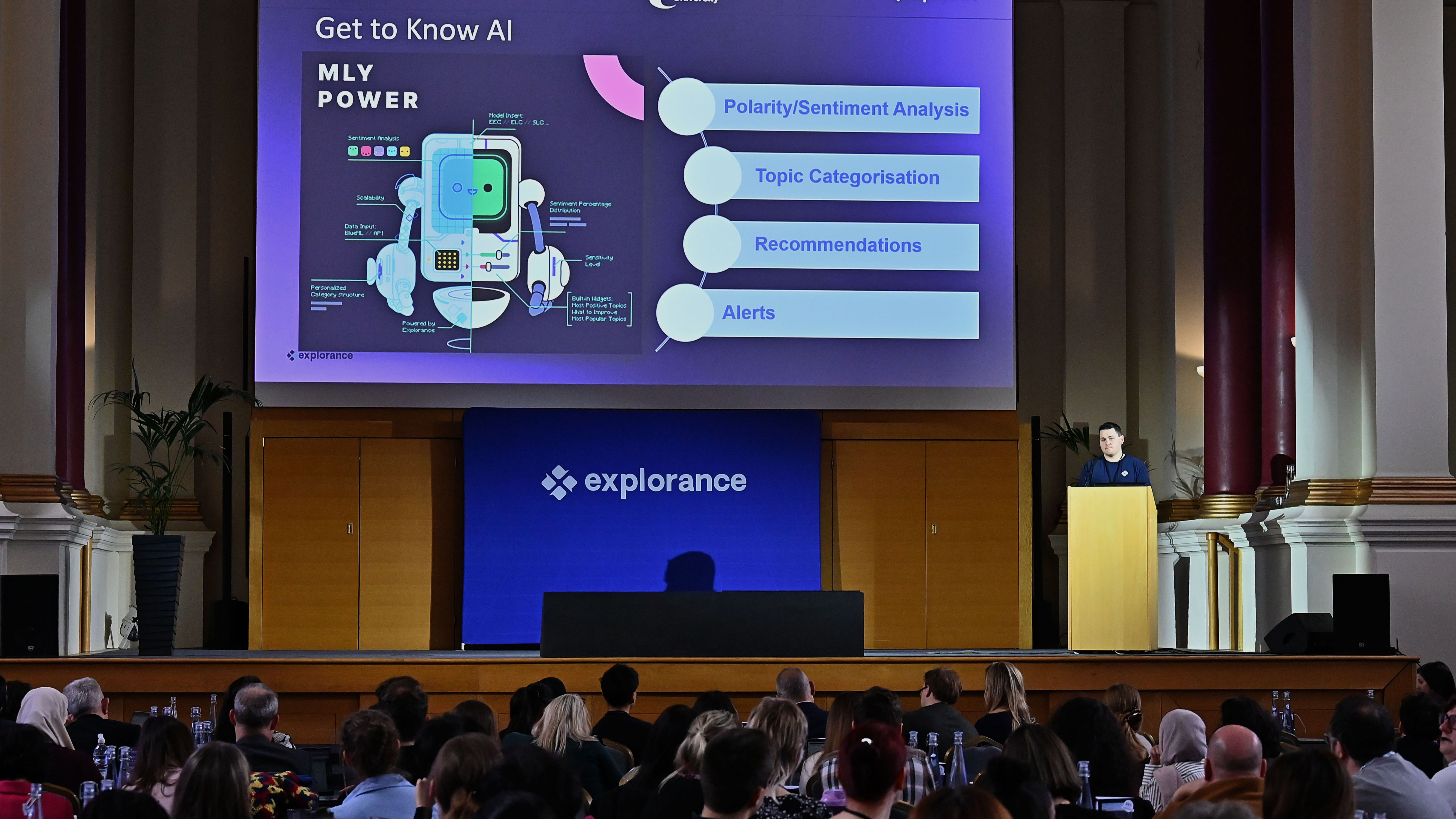

Higher education leaders shared actionable strategies for embedding student voice across governance, feedback systems, and institutional culture at the 2026 Student Voices in Higher Education conference in London. The event featured 16 presentations, two keynotes, and two panel discussions.
Here are some of the biggest highlights that attendees and presenters alike enjoyed at this year’s conference:
1. Compelling Keynotes From Sector Leaders
In his conference-opening keynote, Aston University Deputy Vice-Chancellor (and soon-to-be Vice-Chancellor of the University of South Wales) Professor Osama Khan spoke on Student Voice: A Journey from the Student Staff Liaison Committee (SSLC) to Co-Creation.
He detailed how the first SSLC could be traced back to 1889, as reported by the General report of the Commissioners under the Universities (Scotland) Act, followed by the University of Sheffield, University of Nottingham, University of Cambridge, University of Bristol, and University of Oxford through the mid-1900s.
Professor Khan also traced the first module evaluation survey back to Cambridge University and Clare College, before detailing the “perils” of SSLCs and the pros and cons of student evaluation of modules. He pinpointed how student voice supports the student lifecycle, including:
- Access and admission
- Progression, continuation, and student experience
- Graduate outcomes
“I am a big advocate that if you really care about student voice, you need to be close to student voice. You can’t run it from Senate House,” he said, before discussing curriculum review principles, student staff partnership, and visibility of the partnership model. He praised Explorance for its exceptional tools for module evaluation surveys, data mining, and learning analytics.
Explorance was also honoured to welcome Amira Campbell, President of the National Union of Students (NUS), as our day two keynote speaker. In her presentation, “Rethinking Student Voice From Feedback to Power,” and follow-up Q&A, Amira emphasized the need for universities to listen to what students are already saying.
She said that closing the feedback loop practices need to evolve, and that “whilst we love ‘You Said, We Did’, it also needs to be ‘You Organised, We Changed’.” Student voice has changed, Amira continued, and when asked for examples of difference made, she remarked that the “highlight moment for me is when we are willing to let all changemakers come together”.
2. Leading with Listening: The Transformative Power of Student Voices
Another major highlight from the event was the leadership panel titled “Leading with Listening: The Transformative Power of Student Voices.” Moderated by Professor Brian Green (Deputy Associate Principal, University of Strathclyde), the panel featured:
Dr Jill Hanson, Deputy Provost at Regent College London, and Julie Kapsalis MBE, CEO and Principal at Nescot College, Surrey.
Julie highlighted the challenges facing Nescot in student voice, given that many higher education learners study in the evenings and at weekends. Traditional approaches to student engagement do not always reach these cohorts, meaning institutions must work harder and smarter to ensure their voices are heard and valued.
For Julie, “the learner has to be at the heart of everything we do, for any project”. That requires not only clear channels for feedback but a culture of respect, transparency, and ongoing dialogue. Listening, she emphasised, is the most important starting point, paired with honesty about what can and cannot change.
She also encouraged leaders to look beyond education, drawing inspiration from other sectors, employers, and technology to create more accessible and inclusive engagement methods.
Jill reinforced the strategic importance of listening to key stakeholders, warning that failing to do so is a “massive mistake”. She stressed the need to monitor feedback across different cohorts to identify consistent themes and to communicate clearly how institutions are responding, including through mechanisms such as module and course evaluations.
Crucially, she noted that student voice cannot be confined to a single team. It must be embedded through “structures, systems and processes that formally require student input”, becoming a “golden thread” running throughout the organisation.
3. Student Voice in Practice: Turning Feedback into Meaningful Action
The final panel discussion at the Student Voices conference, titled “Student Voice in Practice: Turning Feedback into Meaningful Action,” brought together Student Union (SU) leaders from Open SU, Aston SU, Bath Spa University SU, Chester SU, and Salford SU.
Vital perspectives shared during this discussion included:
A tougher landscape for student voice
Panellists agreed that the environment for gathering feedback is more challenging than it was 10-15 years ago. Zaki Kaf Al-Ghazal (Salford) described it as a “tough” landscape, where students are harder to reach, and traditional methods no longer deliver meaningful insights. Instead, SUs must “meet students where they are” to capture relevant feedback.
Noah Thorley (Chester) highlighted a corresponding cultural shift. While accountability measures have increased, students are often less willing to engage in formal feedback processes. Many have never been trained or encouraged to see feedback as part of their role in the academic community. As a result, SUs need to be more creative and proactive in fostering a culture where feedback is expected, not optional.
Meanwhile, Ryan Lucas (Bath Spa) reinforced the importance of relevance. Applying traditional engagement structures to a modern student body requires agility. SUs need nimble systems and the right mechanisms to gather the right feedback at the right time.
Practical platforms and initiatives
Approaches discussed ranged from annual surveys linked to frameworks such as the Teaching Excellence Framework (TEF) and Access and Participation Plans, to more representative structures, such as course-level reps, student voice partners, and Union Senates. Some institutions have paid SU leaders and structured networks to ensure sustained engagement.
Whether through online platforms like “Change It” initiatives or advance question submissions to university leadership, the focus is on ensuring feedback feeds directly into decision-making processes and mini-projects that students can see and shape.
One example of student feedback leading to tangible change was Astonbury and Let's CHAT (formerly Speak Week), an initiative presented by Afia Amanoullah (Aston) that amplified student voices and fostered open dialogue on campus.
Building a sustainable culture of partnership
Looking ahead, the panel called for a shift towards a genuine “students as partners” model.
Moving beyond tick-box exercises, SUs and universities must embed student voice within governance and accountability structures so that students feel part of the conversation.
Panellists emphasised keeping feedback simple, being transparent about outcomes, and continually reinforcing the “why” behind engagement. Creating a sense of belonging can help students feel valued and more willing to participate.
4. Empowering Customer Insights
At the start of 2025-26, Bath Spa University entered its third year of Explorance Blue and second year of MLY for student feedback.
Rachel Garman, Student Experience Manager (Digital), outlined the university’s rebranded approach to student voice and objectives to:
- Enhance the quality and relevance of module-level feedback.
- Improve National Student Survey scores across key themes.
- Ensure students see the impact of their feedback.
- Empower staff to use feedback data for continuous improvement.
With a vision “to create a responsive, inclusive, and digitally empowered student voice ecosystem that reflects the diversity of learning or student experiences”, delivered through student feedback, student collaboration, and student voice in decision-making, “Amplify Your Voice” has become an important focus.
Emilia Dunmore, Graduate Student Feedback Coordinator, shared how the four campaign pillars ‘Voice It, Shape It, Live It, See It’ are working in practice and how Explorance is supporting them.
Actively Listening to Student Experiences
Explorance Blue creates and publishes university-wide surveys. Dashboards support module evaluations and display all available surveys for staff and students. Pop-ups integrate directly into the university VLE.
The Welcome Survey, issued through Blue, achieved a 13% increase in responses compared to 2024.
Putting Students at the Heart of Change
Student Community Leaders, Course Reps, and Sabbs connect with committees across the university. Plans are underway to provide SCL-specific Blue reports for sharing data with their communities.
These reports give student leaders direct access to insights they can act on and share back to peers.
Closing the Loop With Students
Module and survey reports are created and published using Blue. Staff and students access these reports directly within their dashboard.
This transparency shows students how their feedback leads to change. “We could not do all this student voice work without Explorance,” Rachel summarised.
Ulster University also presented on its journey with Explorance over the past 18 months. You can read the case study here.
5. From Plenaries to Practical Workshops: The Best of the Rest
In the two plenary sessions, Kirsty Bryant, Jill LeBihan, and Tom Lowe (University of Westminster), Nathaniel Pickering (University of Greenwich), and Ashley Storer-Smith (UCL) presented “Findings of a Sector Audit on Student Voice Practices in UK Higher Education.”
The audit, funded by QAA, examined a range of practices, including module-level evaluation. Here, the researchers said that a single survey per module is most common (53.85%). Alternative or additional practices, “checking in," well-being checks, and informal dialogue, are also prominent, but practices vary.
“Student representation and voice practice continues to be a major priority for UK Higher Education, where 100% respondents are practicing Course Level Representation, 62.23% School or Faculty Level Representation, and 82.05% conducting course evaluations or module level feedback surveys”, they concluded. Their final report is due to be published in March.
Meanwhile, Dr. Michelle Morgan (University of East London) and Jonathan Neves (Advance HE) explored how the first national Pre-arrival Academic Questionnaire can shape and influence national policy, institutional practice, and the student experience. Universities are invited to take part in the second survey window.
Thanks also to other presenters from the University of Westminster, Nescot (in partnership with St George’s, Epsom and St Helier Hospitals and Health Group), University of the Arts London and University College London, as well as Royal Holloway University of London, University of Sussex, Chichester College Group and University of Sunderland in London.
Planning is already underway for the next Student Voices in Higher Education conference, which will be held in Manchester in October 2026!
Phil is a specialist PR, communications, and stakeholder engagement consultant with 22 years' experience in both in-house and consultancy roles. He support universities, multi-academy trusts and schools, as well as commercial organizations targeting the education sector, to support their profile, reputation and business development objectives.
Related Articles





Stay connected with the latest updates and news from Explorance.

'%3e%3cpath%20d='M5.83968%2010.4004L7.09855%2015.7752L1.29959%2021.5843L1.23852%2021.642C1.21137%2021.6692%201.18762%2021.6997%201.16047%2021.7235C0.481112%2022.4372%200.0747675%2023.3674%200.0127211%2024.3508C-0.0493254%2025.3343%200.236888%2026.3082%200.821155%2027.1016C0.885626%2027.1865%200.950095%2027.2713%201.01796%2027.3493C1.0306%2027.3649%201.0442%2027.3796%201.05868%2027.3935C1.16422%2027.5192%201.27755%2027.6382%201.398%2027.7497L1.4455%2027.7939L1.67624%2028.0246L9.14125%2035.4896L20.0334%2024.6043L5.83968%2010.4004Z'%20fill='white'/%3e%3cpath%20d='M13.1078%2039.4493L9.78247%2042.761L15.1539%2041.5055L20.98%2047.3113L21.0411%2047.369L21.1225%2047.4504C21.8375%2048.1288%2022.7681%2048.5345%2023.7517%2048.5965C24.7354%2048.6585%2025.7096%2048.373%2026.5041%2047.7897C26.5889%2047.7253%2026.6737%2047.6608%2026.7518%2047.5929L26.7959%2047.5522C26.9233%2047.4401%2027.0434%2047.3199%2027.1556%2047.1925C27.1709%2047.1795%2027.1845%2047.1647%2027.1963%2047.1484L27.4304%2046.9211L34.8954%2039.4561L23.9999%2028.5605L13.1078%2039.4493Z'%20fill='white'/%3e%3cpath%20d='M34.8921%209.76194L38.2072%206.45019L32.8358%207.70228L27.0199%201.89315L26.9588%201.83207C26.9317%201.80492%2026.9045%201.78117%2026.8808%201.75403C26.1658%201.07561%2025.2352%200.669967%2024.2515%200.607946C23.2679%200.545924%2022.2937%200.831473%2021.4992%201.41471L21.2515%201.61491L21.204%201.65902C21.0833%201.7643%2020.9699%201.87767%2020.8646%201.99833L20.8239%202.04245L20.5932%202.2664L13.1282%209.73141L23.9999%2020.6473L34.8921%209.76194Z'%20fill='white'/%3e%3cpath%20d='M47.1789%2022.1067C47.1181%2022.0204%2047.0524%2021.9377%2046.9821%2021.859L46.9414%2021.8149C46.8301%2021.6867%2046.7099%2021.5665%2046.5817%2021.4552L46.5376%2021.4145L46.3069%2021.1838L38.8419%2013.7188L27.9531%2024.6041L38.8419%2035.4928L42.157%2038.8046L40.9015%2033.4332L46.7073%2027.624L46.7683%2027.5663L46.8464%2027.4815C47.5267%2026.769%2047.9337%2025.8392%2047.9958%2024.856C48.0579%2023.8727%2047.771%2022.8992%2047.1857%2022.1067H47.1789Z'%20fill='%230050C1'/%3e%3c/g%3e%3cdefs%3e%3cclipPath%20id='clip0_6641_12689'%3e%3crect%20width='48'%20height='47.9966'%20fill='white'%20transform='translate(0%200.603516)'/%3e%3c/clipPath%3e%3c/defs%3e%3c/svg%3e)