What Is Scrap Learning? How to Identify, Prevent & Reduce Wasted Training



Scrap learning refers to any portion of training that employees never apply on the job. It is the measurable gap between what is taught in a program and what shows up in workplace behaviors. It is one of the most common and costly challenges in corporate training today.
The term comes from manufacturing, where unused materials were labeled as scrap. L&D adopted the concept to describe training that ends up discarded. This makes scrap learning different from incomplete training or poor-quality training.
Organizations invest heavily in employee development programs, yet much of that investment never delivers performance results. Training that does not stick shows up as forgotten steps, missing skills, or unused techniques. These gaps eventually spread across teams and contribute to low confidence, stalled goals, and inconsistent execution.
Leaders often notice the impact before they can diagnose the cause. Performance stays flat, workloads increase, and managers struggle to understand why employees are not applying what they learned.
This article explains what scrap learning is, why it happens, and how to measure and reduce it. You will learn how to apply analytics, reinforcement strategies, and alignment principles to make training stick.
Why Does Scrap Learning Happen?
Scrap learning has clear root causes. Many appear in the following diagram, which is also laid out in text form below:
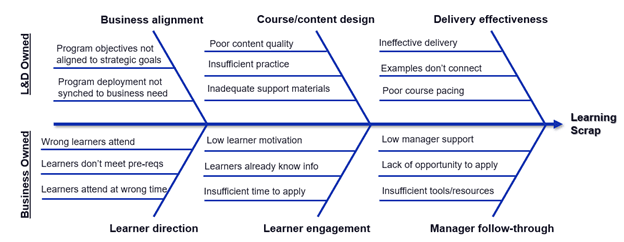
Business alignment
- Program objectives not aligned to strategic goals
- Program deployment not matched to business need
Learner direction
- Wrong learners attend
- Learners don't meet pre-requisites
- Learners attend at wrong time
Course/content design
- Poor content quality
- Insufficient practice
- Inadequate support materials
Learner engagement
- Low learner motivation
- Learners already know info
- Insufficient time to apply
Delivery effectiveness
- Ineffective delivery
- Examples don't connect
- Poor course pacing
Manager follow-through
- Low manager support
- Lack of opportunity to apply
- Insufficient tools/resources
These combined forces create a system where employees learn in the moment but forget quickly. When reinforcement is weak and alignment is low, scrap learning becomes inevitable.
The Hidden Cost of Scrap Learning
Most organizations underestimate the financial impact of scrap learning. Many leaders track training spend, yet few calculate the portion that never delivers results. The cost of unused learning grows quickly across large employee populations.
One way to estimate the financial impact is to calculate the percentage of training unlikely to be used and multiply it by the cost per learner. This method reveals the amount of training budget waste before performance value is considered. It also illustrates the cost of ineffective corporate learning across time, resources, and missed opportunities.
Hidden costs include:
- Employee time away from core responsibilities
- Manager time spent supporting ineffective training
- Repetition of training due to low retention
- Declines in productivity that occur when skills are not applied
Understanding these financial implications helps leaders see that scrap learning is more than a training issue. It is a business performance issue that requires data-driven improvement.
Signs Your Organization Has a Scrap Learning Problem
Scrap learning shows up in ways that leaders can see long before they measure it. These indicators often appear in performance reviews, assessments, and manager feedback cycles.
Lack of behavior change post-training
Employees return to previous habits instead of using new skills. This reflects low transfer of training and signals the need for stronger reinforcement.
No improvement in knowledge or skills
Assessment scores remain flat after training. This creates clear evidence of low training retention and weak learning outcomes.
Managers report little impact
Managers see no measurable shift in performance indicators. This reduces confidence in the program and raises questions about training ROI.
Employees feel unprepared
Learners struggle to complete tasks or apply skills, even when training seemed successful. Confidence drops quickly without clear support.
Repeated retraining
Teams revisit programs because the first attempt did not lead to behavior change. This creates additional costs and disrupts workflow.
If even one of these symptoms appears, your training ecosystem may have a scrap learning challenge. Understanding what is scrap learning provides the clarity needed to fix underlying issues and support consistent performance improvement.
How to Measure Scrap Learning
You cannot reduce scrap learning without measuring it. Effective measurement helps organizations identify where the transfer of training is breaking down. It also reveals how much learning is being retained over time.
Pre- and post-training assessments
Comparing performance before and after training shows how much knowledge learners gain. When scores improve but behavior does not, scrap learning is likely occurring.
Managerial feedback
Managers offer firsthand insight into whether employees apply what they learned. Their observations help diagnose the skill application gap and reveal where training is not sticking.
Real-time performance analytics
Modern learning measurement tools allow leaders to track learner behavior, confidence, and performance trends. This creates stronger training ROI metrics and more accurate data-driven learning assessments.
When these measurement methods are combined, organizations get a complete understanding of what is scrap learning and how to reduce it. They also gain a clearer view of which programs deliver genuine business impact.
How to Reduce Scrap Learning
Reducing scrap learning requires a strategy that addresses alignment, reinforcement, and personalization. These interventions help learners connect content to their role and retain skills long after training ends.
Align training with job roles and KPIs
Training must reflect the tasks, decisions, and tools employees use daily. When learning ties directly to role requirements, learners engage more and transfer increases.
Reinforce learning post-training
Reinforcement ensures long-term skill retention. Techniques include:
- Coaching
- Spaced repetition
- On-the-job assignments
- Microlearning reinforcement
- Peer practice sessions
When reinforcement is consistent, learners are less likely to forget what they learned.
Use adaptive learning technologies
Adaptive platforms personalize content based on skill levels, confidence, and performance patterns. This supports personalized learning paths that prevent overload.
Support competency-based training models
Competency models focus on demonstrations of skill, not just knowledge retention. These models reduce scrap learning by requiring real-world application before training is considered complete.
Connecting these strategies back to earlier root causes ensures that organizations solve the full system, not the surface-level symptoms. When teams understand what is scrap learning, these strategies become easier to implement at scale.
The Role of Learning Analytics in Preventing Scrap Learning
Learning analytics is one of the most powerful ways to reduce scrap learning. Data helps organizations identify risk factors before they impact performance. It also allows leaders to personalize learning and reinforce skills more effectively.
Identify at-risk learners
Using predictive learning analytics, organizations can see which learners may struggle with content or confidence. Early intervention prevents forgotten training and reduces scrap learning.
Improve content relevance
Analytics show which modules have low engagement or low comprehension. These insights help eliminate content overload and allow instructional designers to refine course materials.
Support managers with real-time data
When managers have access to employee engagement dashboards, they can provide targeted coaching and follow-up. This improves learning retention and increases transfer of training.
Enable continuous improvement
Platforms like Explorance support real-time feedback loops. These loops highlight how learners feel, where they struggle, and what support they need. This strengthens workplace learning analytics strategies and improves long-term performance impact.
Learning analytics reduces scrap learning by turning data into action. It helps organizations reinforce skills, personalize training, and close transfer gaps before they grow.
Frequently Asked Questions About Scrap Learning
1. What is an example of scrap learning in corporate training?
A common example is when employees complete a compliance course, pass the assessment, and still fail to follow the guidelines at work. This indicates training was learned but not applied.
2. How can managers identify scrap learning early?
Managers can watch for employees reverting to old habits, showing low confidence, or asking questions that training should have answered. Early signs appear during performance conversations and coaching sessions.
3. What is the difference between ineffective learning and scrap learning?
Ineffective learning occurs when employees never learn the content in the first place. Scrap learning occurs when employees learn the content but never use it.
4. Can different delivery methods reduce scrap learning?
Yes. Blended learning, coaching, adaptive platforms, and microlearning reinforcement all help learners apply skills more consistently.
5. How do you calculate training ROI?
Training ROI is calculated by estimating the financial value of performance improvement and subtracting training costs and scrap learning losses. This equation shows how well a program converts training investment into business value.
Avoid Scrap Learning and Your Make Training Stick
Scrap learning is preventable when organizations understand what is scrap learning, why it happens, and how to reduce it. Training becomes more effective when leaders connect learning to job roles, reinforce skills consistently, and use analytics to guide decisions. These strategies help organizations turn learning investments into measurable performance improvement.
To make training stick, audit your training programs and evaluate your transfer of training rates. Then apply data-driven insights to strengthen your employee development programs. With the right tools and systems, every learning experience can lead to real capability building across your workforce.
With over six years at Explorance and more than two decades in Learning and Development, Steve specializes in building sustainable measurement frameworks that empower organizations to align learning outcomes with business priorities.
Related Articles






Learn more about Explorance's products, solutions, and the company.

'%3e%3cpath%20d='M5.83968%2010.4004L7.09855%2015.7752L1.29959%2021.5843L1.23852%2021.642C1.21137%2021.6692%201.18762%2021.6997%201.16047%2021.7235C0.481112%2022.4372%200.0747675%2023.3674%200.0127211%2024.3508C-0.0493254%2025.3343%200.236888%2026.3082%200.821155%2027.1016C0.885626%2027.1865%200.950095%2027.2713%201.01796%2027.3493C1.0306%2027.3649%201.0442%2027.3796%201.05868%2027.3935C1.16422%2027.5192%201.27755%2027.6382%201.398%2027.7497L1.4455%2027.7939L1.67624%2028.0246L9.14125%2035.4896L20.0334%2024.6043L5.83968%2010.4004Z'%20fill='white'/%3e%3cpath%20d='M13.1078%2039.4493L9.78247%2042.761L15.1539%2041.5055L20.98%2047.3113L21.0411%2047.369L21.1225%2047.4504C21.8375%2048.1288%2022.7681%2048.5345%2023.7517%2048.5965C24.7354%2048.6585%2025.7096%2048.373%2026.5041%2047.7897C26.5889%2047.7253%2026.6737%2047.6608%2026.7518%2047.5929L26.7959%2047.5522C26.9233%2047.4401%2027.0434%2047.3199%2027.1556%2047.1925C27.1709%2047.1795%2027.1845%2047.1647%2027.1963%2047.1484L27.4304%2046.9211L34.8954%2039.4561L23.9999%2028.5605L13.1078%2039.4493Z'%20fill='white'/%3e%3cpath%20d='M34.8921%209.76194L38.2072%206.45019L32.8358%207.70228L27.0199%201.89315L26.9588%201.83207C26.9317%201.80492%2026.9045%201.78117%2026.8808%201.75403C26.1658%201.07561%2025.2352%200.669967%2024.2515%200.607946C23.2679%200.545924%2022.2937%200.831473%2021.4992%201.41471L21.2515%201.61491L21.204%201.65902C21.0833%201.7643%2020.9699%201.87767%2020.8646%201.99833L20.8239%202.04245L20.5932%202.2664L13.1282%209.73141L23.9999%2020.6473L34.8921%209.76194Z'%20fill='white'/%3e%3cpath%20d='M47.1789%2022.1067C47.1181%2022.0204%2047.0524%2021.9377%2046.9821%2021.859L46.9414%2021.8149C46.8301%2021.6867%2046.7099%2021.5665%2046.5817%2021.4552L46.5376%2021.4145L46.3069%2021.1838L38.8419%2013.7188L27.9531%2024.6041L38.8419%2035.4928L42.157%2038.8046L40.9015%2033.4332L46.7073%2027.624L46.7683%2027.5663L46.8464%2027.4815C47.5267%2026.769%2047.9337%2025.8392%2047.9958%2024.856C48.0579%2023.8727%2047.771%2022.8992%2047.1857%2022.1067H47.1789Z'%20fill='%230050C1'/%3e%3c/g%3e%3cdefs%3e%3cclipPath%20id='clip0_6641_12689'%3e%3crect%20width='48'%20height='47.9966'%20fill='white'%20transform='translate(0%200.603516)'/%3e%3c/clipPath%3e%3c/defs%3e%3c/svg%3e)