Reimagining Student Voice: From Historical Structures to Continuous Dialogue


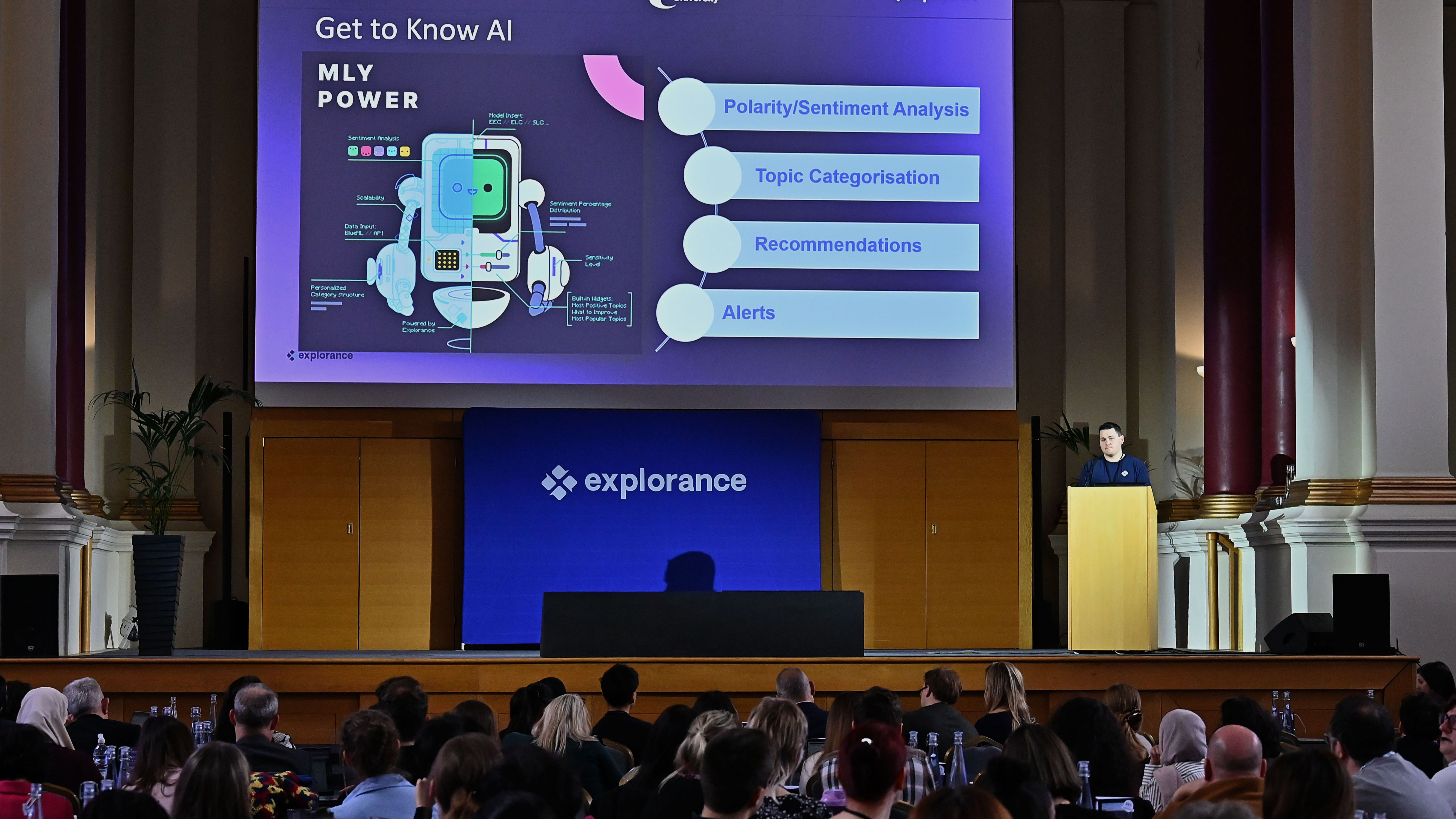
Professor Osama Khan, currently Deputy Vice-Chancellor (Academic) at Aston University, delivered a keynote titled "Student Voice: A Journey from SSLC to Co-Creation" at the Student Voices in Higher Education Conference in London last month. Professor Khan, who will take up the role of Vice-Chancellor and Chief Executive of the University of South Wales in May 2026, has now contributed this follow-up summary blog.
Student voice has become a central concept in modern higher education. Universities regularly emphasise the importance of listening to students, gathering feedback, and responding to their experiences. Yet despite the prominence of the term, it is worth asking whether the mechanisms we rely on today genuinely reflect what meaningful student voice should look like.
In my recent keynote for Explorance, I highlighted an important paradox. Universities have a long and proud tradition of engaging students in governance and decision-making, but many of the structures that underpin this engagement have changed remarkably little over time.
Historical records suggest that formal student consultation in universities dates back well over a century. In Scotland, legislation as early as 1889 recognised the importance of consulting students, particularly in the context of medical education.
Throughout the 20th century, universities across the UK continued to develop formal mechanisms for student representation. Archives from institutions such as University of Sheffield show records of Student-Staff Liaison Committee (SSLC) meetings between 1939 and 1960.
Similar documentation exists at University of Nottingham from the early 1960s, while departments at the University of Cambridge and University of Oxford were also documenting student engagement processes during the same period. The University of Bristol holds comparable records from the mid-1960s.
These examples demonstrate that universities have long understood the importance of listening to students. However, they also reveal something more challenging: many of the structures created decades ago still sit at the centre of student engagement today.
The SSLC remains a cornerstone of governance in many institutions. While it provides an important forum for dialogue, relying on a model that originated in the 19th century raises an uncomfortable question: Have universities genuinely evolved how they listen to students, or have we simply preserved historic mechanisms without fundamentally rethinking them?
There are several reasons why traditional approaches to student voice can fall short.
One of the most obvious challenges lies in the dynamics of committee meetings themselves. Student representatives often find themselves sitting in a room dominated by academics and administrators. Even confident students may find it difficult to challenge teaching practices or raise concerns directly with staff responsible for their education. The power imbalance can make honest conversations harder than institutions might assume.
Representation is another issue. Students who volunteer to become representatives are frequently highly engaged and confident individuals, which is valuable. However, this also means that quieter voices - particularly those from underrepresented backgrounds - may not always be heard. When representation relies heavily on self-selection, the diversity of student perspectives can be limited.
Timing can also present difficulties. Many feedback mechanisms operate at the end of a module or academic year. By the time concerns are raised, the opportunity to address them for the current cohort may already have passed. In effect, students are often providing feedback that will only benefit those who come after them. While many students are willing to do this, it places an expectation of altruism on learners who are paying significant tuition fees and navigating demanding academic experiences.
For these reasons, student voice needs to move beyond periodic consultations and toward something more continuous and responsive. Rather than relying primarily on annual surveys or occasional committee meetings, universities should think about how they can maintain an ongoing dialogue with students throughout their learning journey.
Technology offers opportunities to support this shift. Learning analytics systems, for example, allow institutions to track patterns of engagement and identify emerging challenges early. Institutions such as Nottingham Trent University have been pioneers in developing analytics approaches that provide insights into student participation and academic progress. When used thoughtfully, these tools can highlight issues such as declining engagement or barriers to learning long before they appear in formal surveys.
Digital platforms can also enable more regular feedback from students. Instead of waiting until the end of a module, students can raise issues during the semester, while staff have the opportunity to respond quickly. This creates a more dynamic relationship between students and the institution, where feedback becomes part of everyday academic life rather than an annual exercise.
However, student voice should not be limited to what happens during a student's time on campus. In reality, it begins much earlier.
Universities often overlook the valuable insights held by their marketing and recruitment teams. These colleagues speak with prospective students every day and have a deep understanding of what applicants expect from university education. They know what attracts students to particular courses, what messages resonate in recruitment campaigns, and what promises institutions make during the admissions process.
If the experience students encounter after enrolment differs significantly from those expectations, dissatisfaction is almost inevitable. Listening to student voice therefore requires universities to connect feedback across the entire student lifecycle, from initial interest and application through to graduation and employment.
Another important dimension of student voice concerns the relationship between leadership and teaching. Many senior academics in universities today no longer teach regularly. Yet they remain responsible for shaping strategies for education and student experience. This distance from the classroom can create a disconnect between policy and practice.
Continuing to teach can help leaders remain grounded in the realities of modern higher education. It allows them to experience directly the challenges faced by students and staff alike, from evolving learning technologies to changing student expectations. Remaining close to teaching ensures that discussions about student voice are informed by lived experience rather than abstract policy.
Surveys remain one of the most visible tools for capturing student voice. In the UK, the National Student Survey has provided a consistent national measure of student satisfaction since 2006. Few sectors anywhere in the world collect feedback from their participants at such scale and with such high response rates.
Yet surveys are sometimes misunderstood. When results are disappointing, the first reaction may be to question the data or the response rate. But surveys should not be viewed simply as judgments of individual teaching performance. Instead, they offer insight into how effectively teaching practices create conditions that support student learning.
This distinction matters because learning itself is a complex and deeply personal process. It is shaped by motivation, background knowledge, confidence, and social context. No survey can perfectly measure whether learning has occurred. What it can do is reveal whether students feel supported in their efforts to learn.
Concerns about bias in student feedback are also frequently raised, and these concerns should be taken seriously. Research shows that demographic factors such as gender, ethnicity, and accent can influence evaluation scores. Staff from minority backgrounds may therefore experience systematic disadvantages in survey results.
Addressing this issue requires careful analysis rather than abandoning student voice altogether. Institutions can examine feedback data alongside demographic information to identify patterns and contextualise results. Recognising potential bias allows universities to interpret survey outcomes more fairly while still benefiting from the insights that student feedback provides.
Transparency plays a crucial role in ensuring that student voice leads to meaningful improvement. Too often, feedback data is confined to small groups of senior leaders or central teams. A more productive approach is to share insights widely across the academic community through accessible dashboards and clear visualisations. When data becomes visible, it encourages collective reflection and enables departments to identify areas where support or innovation may be needed.
Importantly, the purpose of sharing this information should not be to punish staff whose results are less positive. Instead, it should foster a culture of improvement in which feedback is used constructively to enhance teaching and learning.
Another way to strengthen student voice is through partnership in curriculum design. Traditional academic culture has often assumed that curricula are designed primarily by academics based on their disciplinary expertise. While subject knowledge remains essential, students themselves bring valuable perspectives about how learning happens in practice.
Co-creation approaches invite students to contribute to decisions about curriculum structure, learning activities, and assessment methods. This can be particularly important in supporting diverse learners. For example, offering different forms of assessment within a module may allow students with different strengths - including neurodiverse learners - to demonstrate their understanding more effectively.
At Aston University, initiatives such as a student-staff partnership manifesto have sought to formalise this collaborative approach. By articulating shared expectations between students and staff, the manifesto signals that partnership is not simply rhetorical but embedded in the institution's values.
Finally, meaningful student voice requires attention to lived experience. Quantitative surveys provide valuable data, but they cannot capture the full complexity of student life. Qualitative engagement - through conversations, focus groups, and partnerships with student societies - helps institutions understand the realities behind the numbers.
This is particularly important when addressing persistent inequalities in higher education. For example, when universities seek to tackle awarding gaps affecting specific student communities, meaningful progress often depends on listening directly to those students and working with them to develop solutions.
Ultimately, student voice is most powerful when it combines multiple forms of evidence. Surveys, analytics, conversations, and partnerships all contribute different insights. Together they create a richer understanding of how students experience university life.
If higher education is to continue evolving, listening to students must go beyond symbolic consultation. It requires a commitment to continuous dialogue, transparency, and partnership. Universities must move beyond the structures they inherited from previous generations and build systems that reflect the realities of contemporary education.
Student voice should not be something that happens occasionally in committee rooms or annual surveys. It should be a living part of institutional culture - shaping decisions, guiding improvements, and reminding universities of the people at the heart of their mission.
Listening to students is not just about hearing what they say. It is about creating universities that learn from their students as actively as students learn from them.
Related Articles





Stay connected with the latest updates and news from Explorance.

'%3e%3cpath%20d='M5.83968%2010.4004L7.09855%2015.7752L1.29959%2021.5843L1.23852%2021.642C1.21137%2021.6692%201.18762%2021.6997%201.16047%2021.7235C0.481112%2022.4372%200.0747675%2023.3674%200.0127211%2024.3508C-0.0493254%2025.3343%200.236888%2026.3082%200.821155%2027.1016C0.885626%2027.1865%200.950095%2027.2713%201.01796%2027.3493C1.0306%2027.3649%201.0442%2027.3796%201.05868%2027.3935C1.16422%2027.5192%201.27755%2027.6382%201.398%2027.7497L1.4455%2027.7939L1.67624%2028.0246L9.14125%2035.4896L20.0334%2024.6043L5.83968%2010.4004Z'%20fill='white'/%3e%3cpath%20d='M13.1078%2039.4493L9.78247%2042.761L15.1539%2041.5055L20.98%2047.3113L21.0411%2047.369L21.1225%2047.4504C21.8375%2048.1288%2022.7681%2048.5345%2023.7517%2048.5965C24.7354%2048.6585%2025.7096%2048.373%2026.5041%2047.7897C26.5889%2047.7253%2026.6737%2047.6608%2026.7518%2047.5929L26.7959%2047.5522C26.9233%2047.4401%2027.0434%2047.3199%2027.1556%2047.1925C27.1709%2047.1795%2027.1845%2047.1647%2027.1963%2047.1484L27.4304%2046.9211L34.8954%2039.4561L23.9999%2028.5605L13.1078%2039.4493Z'%20fill='white'/%3e%3cpath%20d='M34.8921%209.76194L38.2072%206.45019L32.8358%207.70228L27.0199%201.89315L26.9588%201.83207C26.9317%201.80492%2026.9045%201.78117%2026.8808%201.75403C26.1658%201.07561%2025.2352%200.669967%2024.2515%200.607946C23.2679%200.545924%2022.2937%200.831473%2021.4992%201.41471L21.2515%201.61491L21.204%201.65902C21.0833%201.7643%2020.9699%201.87767%2020.8646%201.99833L20.8239%202.04245L20.5932%202.2664L13.1282%209.73141L23.9999%2020.6473L34.8921%209.76194Z'%20fill='white'/%3e%3cpath%20d='M47.1789%2022.1067C47.1181%2022.0204%2047.0524%2021.9377%2046.9821%2021.859L46.9414%2021.8149C46.8301%2021.6867%2046.7099%2021.5665%2046.5817%2021.4552L46.5376%2021.4145L46.3069%2021.1838L38.8419%2013.7188L27.9531%2024.6041L38.8419%2035.4928L42.157%2038.8046L40.9015%2033.4332L46.7073%2027.624L46.7683%2027.5663L46.8464%2027.4815C47.5267%2026.769%2047.9337%2025.8392%2047.9958%2024.856C48.0579%2023.8727%2047.771%2022.8992%2047.1857%2022.1067H47.1789Z'%20fill='%230050C1'/%3e%3c/g%3e%3cdefs%3e%3cclipPath%20id='clip0_6641_12689'%3e%3crect%20width='48'%20height='47.9966'%20fill='white'%20transform='translate(0%200.603516)'/%3e%3c/clipPath%3e%3c/defs%3e%3c/svg%3e)