The Biggest Student Voice Takeaways from the 2025 Explorance London Impact Tour



The 2025 edition of the Explorance London Impact Tour saw over 100 higher education delegates attend a hybrid event. The ensuing conversations shed light on how innovation, ideas, and impact are shaping approaches to student voice.
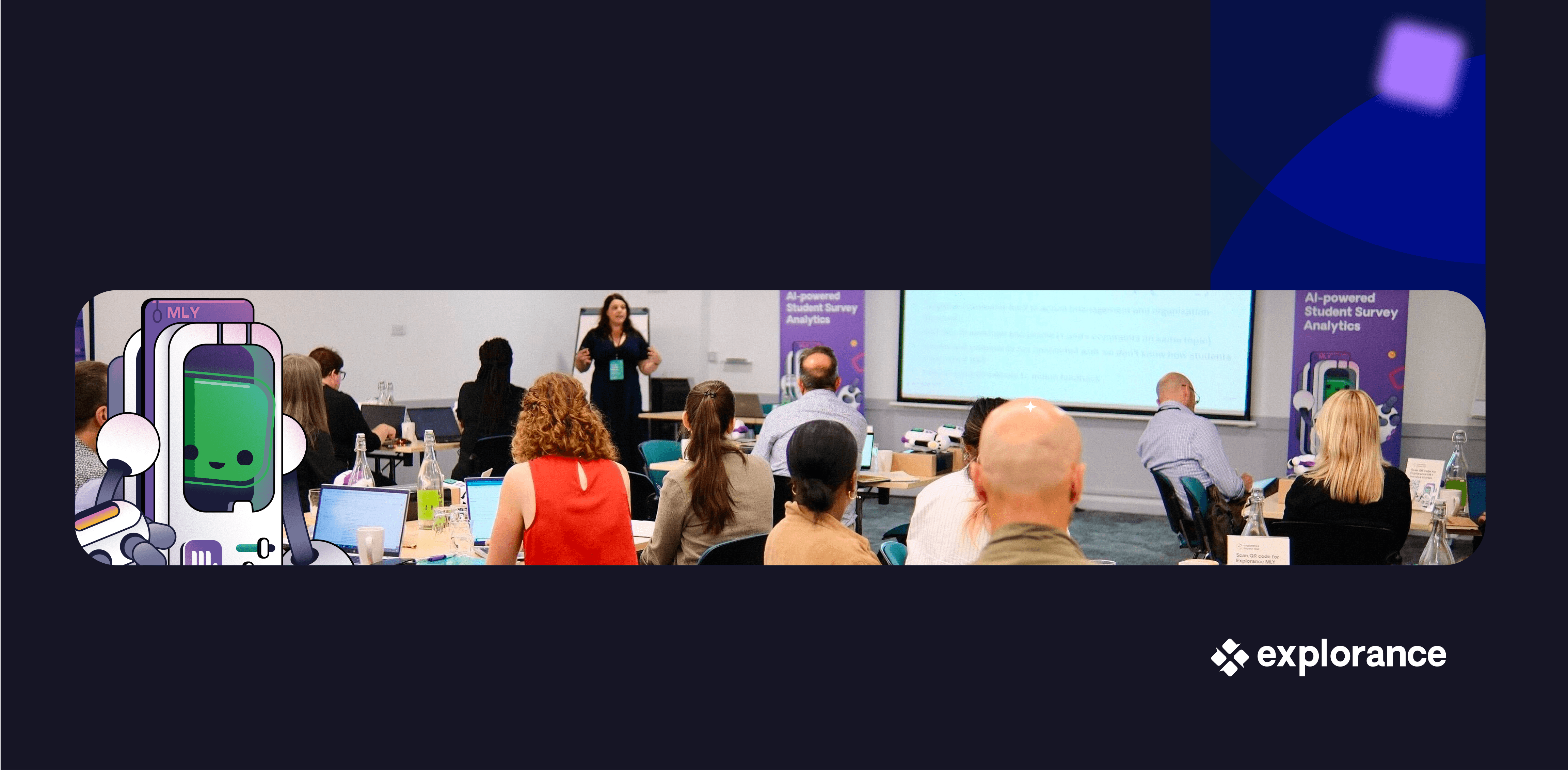
Titled Amplifying Student Voices: Best Practices in Student Feedback Analytics, Explorance was joined by mainly UK-based academic leaders in teaching & learning, student experience, academic quality, institutional research, and IT.
The one-day event featured institution-led discussions focusing on best practices and successful strategies to strengthen engagement with student voice initiatives and boost response rates in feedback and evaluations.
Here's a round-up of the biggest student voice-related takeaways from this exciting event:
The Listening Project: Building Trustful Spaces with Students and Colleagues
Professor Claire Hamshire, Associate Pro Vice-Chancellor, Education & Student Experience at the University of Salford, opened her keynote with a question for attendees: How do institutions create meaningful engagement, foster dialogue, and embed the student voice in decision-making?
She spoke about the principles of trust, building a shared vocabulary, and two crucial underlying concepts that enable this:
- Trust spaces: physical, virtual, or social that encourage the sharing of ideas, experiences, and concerns without fear of judgment or reprisal.
- Trust conversations: specifically aimed at building or restoring trust; requires commitment to transparency, vulnerability, and mutual respect.
Professor Hamshire detailed her collaborative research, including these recent publications:
- Empowering student partners: Reflections on the dynamics of student-staff partnerships
- My input was actually being listened to and could lead to real change: Developing trust through student voice in student-staff partnerships
Killer Statistics: Institutional Journeys with Explorance Blue and MLY
Kingston University implemented the Explorance Blue feedback analytics platform when it reintroduced module evaluation questionnaires (MEQs) in 2017. Fast forward to July 2025 and engagement with module evaluation reached its highest (34.6%).
In her presentation slides titled 'How long do you think it took us to analyse NSS comments centrally?' Student Voice Manager Rebecca Hampstead revealed that, before using Explorance MLY, two staff members reviewing the 3,321 comments received in response to the 2024 National Student Survey would take three weeks
With MLY, that same process takes around five minutes.
She explained: "We used to manually code NSS comments in spreadsheets. Analysis took considerable time and resources and prevented us from providing insight quickly. MLY meant that for the first time ever, we were to provide on-the-day qualitative insights for leadership."
On MEQs, Rebecca added:
"With 26,340 comments received in module evaluation surveys in 2023-24 alone, we had never fully analysed all module evaluation comments centrally, and capacity for central analysis was very limited. By NSS standards, it would have taken us around 26 weeks to do so. With MLY, we were able to provide qualitative insight in top-level reports, and this took around 15-20 minutes."
Meanwhile, Rutgers University and Dr Christina Bifulco, Associate Director for Teaching & Learning Analytics, detailed how Blue has been used for "rebuilding student surveys for strength and flexibility." During her presentation she summarised its impressive impact:
- Departments and schools have been able to obtain more actionable feedback
- That feebdack can be directly linked to support of continuous improvement
- Increased ownership and buy-in of schools and departments
For even more examples of how institutions are enhancing the student voice with the latest in technology and strategy, check out the blog from the Student Voices in Higher Education event.
Why Amplifying Student Voice is More Important Than Ever Before
A real highlight was the Amplifying Student Voices: Best Practices in Student Feedback Analytics panel discussion moderated by Dr Michelle Morgan, Dean of Students at the University of East London. The panel included Professor Hamshire; Dr Bo Kelestyn, Associate Professor at Warwick Business School; and Tom Lowe, Assistant Head of School (Student Experience) at the University of Westminster and Chair of the RAISE Network.
These were the key discussion points:
- The panel emphasised the importance of co-creation and partnership in managing student expectations and developing a mix of quantitative and qualitative opportunities for all voices to be heard - from surveys to focus groups and other student panels, so the diverse student body is involved in giving institutional feedback and that universities are ultimately reimagining, rethinking and innovating with contributed student voice.
- Closing the feedback loop was encouraged, as was doing so from the very first survey. By following this standard, institutions set a precedent to students for how their input will be used. The panel also reiterated the importance of psychological safety in giving feedback, and that feedback should be used for development only, not "as a stick to beat people with". Culturally, a 'grand narrative' on why institutions are collecting voice and how this will be used in a developmental way was suggested to foster staff/student engagement.
- Leaders were especially excited about the potential of AI for speeding up thematic feedback. Qualitative sources, and AI-powered platforms such as Explorance MLY, also bring an opportunity to go beyond the data and dig deeper into stories to ensure that lived experiences are understood. Institutions should be careful not to process with social and emotional experiences into numbers.
AI as an Amplifier, Empathy as the Anchor: Designing Together for Student Engagement
In her closing keynote, Dr. Kelestyn shared reflections on how we balance the use of AI and design thinking to ensure we continue to anchor our co-creation work in empathy and inclusion.
Dr Kelestyn also shared details of Designing Together, a mindset and an accompanying deck of cards for educational leaders, be that students, faculty, or professional services, seeking to create human-centred change with and for their communities.
She left delegates with three questions to consider:
- How might we create/leave space for dialogue that cultivates patience and trust?
- How might we truly reimagine instead of just reproducing?
- How might we leverage AI as an amplifier while maintaining empathy as the anchor?
Reimagining the Future of Feedback in the U.K
The 2025 Explorance London Impact Tour made is clear that listening is changing. Student feedback has evolved from a static exercise to a living, breathing system built on trust, empathy, and actionable insight.
Across every discussion from this Impact Tour event, delegates shared a common vision: to make student voice a continuous dialogue rather than a one-way report. From co-creation and psychological safety to AI-powered analysis that helps uncover meaning faster, institutions are reshaping how they engage, respond, and grow with their students.
What will your institution do?
Phil is a specialist PR, communications, and stakeholder engagement consultant with 22 years' experience in both in-house and consultancy roles. He support universities, multi-academy trusts and schools, as well as commercial organizations targeting the education sector, to support their profile, reputation and business development objectives.
Related Articles





Learn more about Explorance's products, solutions, and the company.

'%3e%3cpath%20d='M5.83968%2010.4004L7.09855%2015.7752L1.29959%2021.5843L1.23852%2021.642C1.21137%2021.6692%201.18762%2021.6997%201.16047%2021.7235C0.481112%2022.4372%200.0747675%2023.3674%200.0127211%2024.3508C-0.0493254%2025.3343%200.236888%2026.3082%200.821155%2027.1016C0.885626%2027.1865%200.950095%2027.2713%201.01796%2027.3493C1.0306%2027.3649%201.0442%2027.3796%201.05868%2027.3935C1.16422%2027.5192%201.27755%2027.6382%201.398%2027.7497L1.4455%2027.7939L1.67624%2028.0246L9.14125%2035.4896L20.0334%2024.6043L5.83968%2010.4004Z'%20fill='white'/%3e%3cpath%20d='M13.1078%2039.4493L9.78247%2042.761L15.1539%2041.5055L20.98%2047.3113L21.0411%2047.369L21.1225%2047.4504C21.8375%2048.1288%2022.7681%2048.5345%2023.7517%2048.5965C24.7354%2048.6585%2025.7096%2048.373%2026.5041%2047.7897C26.5889%2047.7253%2026.6737%2047.6608%2026.7518%2047.5929L26.7959%2047.5522C26.9233%2047.4401%2027.0434%2047.3199%2027.1556%2047.1925C27.1709%2047.1795%2027.1845%2047.1647%2027.1963%2047.1484L27.4304%2046.9211L34.8954%2039.4561L23.9999%2028.5605L13.1078%2039.4493Z'%20fill='white'/%3e%3cpath%20d='M34.8921%209.76194L38.2072%206.45019L32.8358%207.70228L27.0199%201.89315L26.9588%201.83207C26.9317%201.80492%2026.9045%201.78117%2026.8808%201.75403C26.1658%201.07561%2025.2352%200.669967%2024.2515%200.607946C23.2679%200.545924%2022.2937%200.831473%2021.4992%201.41471L21.2515%201.61491L21.204%201.65902C21.0833%201.7643%2020.9699%201.87767%2020.8646%201.99833L20.8239%202.04245L20.5932%202.2664L13.1282%209.73141L23.9999%2020.6473L34.8921%209.76194Z'%20fill='white'/%3e%3cpath%20d='M47.1789%2022.1067C47.1181%2022.0204%2047.0524%2021.9377%2046.9821%2021.859L46.9414%2021.8149C46.8301%2021.6867%2046.7099%2021.5665%2046.5817%2021.4552L46.5376%2021.4145L46.3069%2021.1838L38.8419%2013.7188L27.9531%2024.6041L38.8419%2035.4928L42.157%2038.8046L40.9015%2033.4332L46.7073%2027.624L46.7683%2027.5663L46.8464%2027.4815C47.5267%2026.769%2047.9337%2025.8392%2047.9958%2024.856C48.0579%2023.8727%2047.771%2022.8992%2047.1857%2022.1067H47.1789Z'%20fill='%230050C1'/%3e%3c/g%3e%3cdefs%3e%3cclipPath%20id='clip0_6641_12689'%3e%3crect%20width='48'%20height='47.9966'%20fill='white'%20transform='translate(0%200.603516)'/%3e%3c/clipPath%3e%3c/defs%3e%3c/svg%3e)